It was a given, when I was a child, that I, along with the children around me would go to college. College, we were told, was the key to getting jobs with good companies, making friends, and having a better life.
It’s more complicated for the current generation, as well as for working adults that have not had the opportunity to complete college. Is college worth it? I wondered whether or not to tell students and clients that college is still a good investment.
College and graduate school studies are not the only options today. There are a myriad of apprenticeships, professional certifications, and online courses now. And employers are beginning to take these alternatives seriously. Nonetheless, federal government statistics suggest that formal university-level training continues to offer a significant return-on-investment (ROI) in the job market.
There are at least four reasons to push onward with education:
- Your salary will probably be greater,
- The chances of being unemployed will be smaller,
- You will benefit even if you do not complete that degree, and
- Degree-granting programs are not the only option.
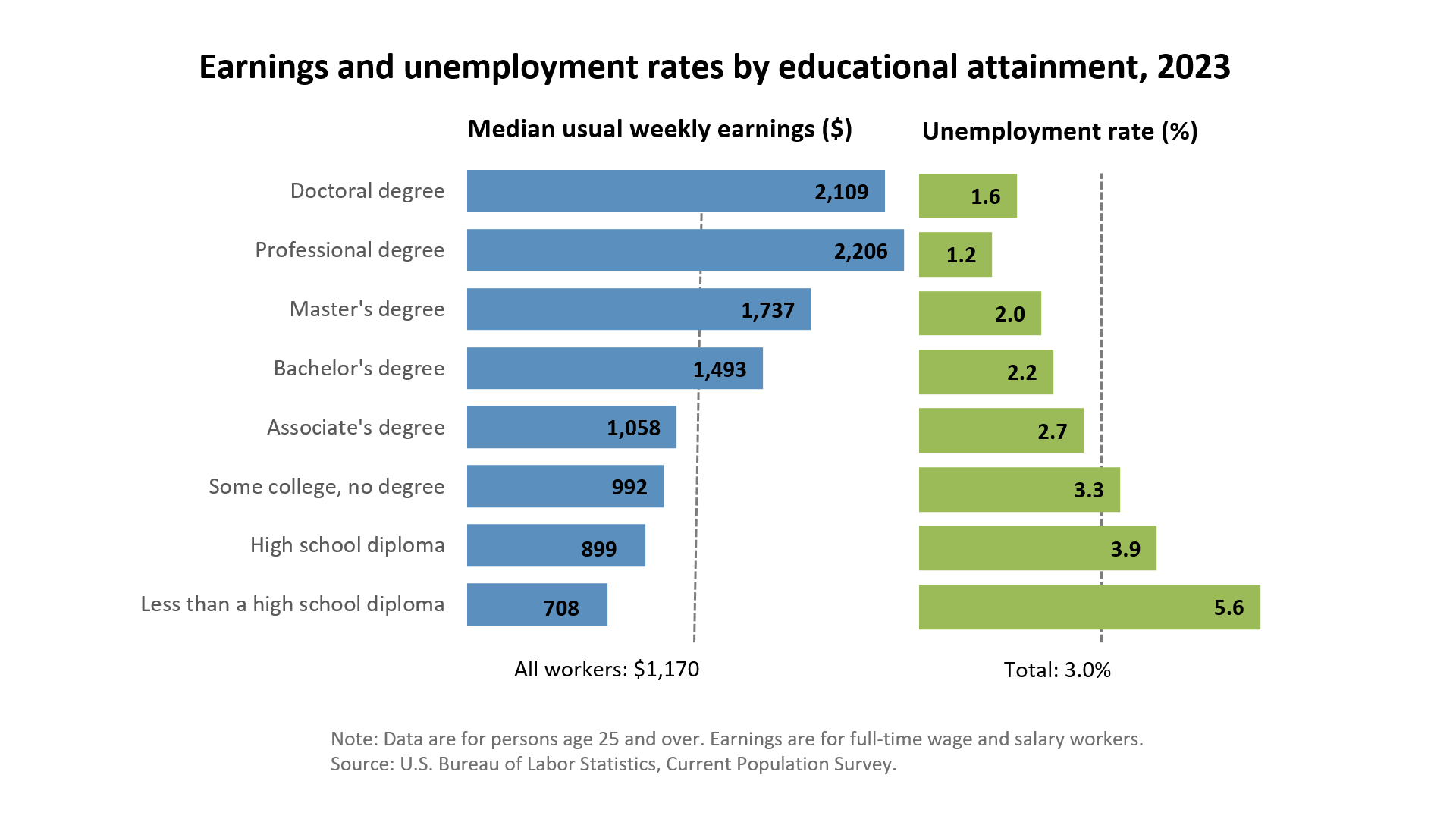
The urging boomers such as myself heard from school counselors, parents, and friends is still supported in 21st Century statistics. An August, 2024 update posted on the Bureau of Labor Statistics Website convincingly demonstrates that you are likely to earn more when you learn more, per the chart below:
| Earnings and unemployment rates by educational attainment, 2023 | ||
| Educational attainment | Median usual weekly earnings | Unemployment rate ($) |
| Doctoral degree | $2,109 | 1.6 |
| Professional degree | 2,206 | 1.2 |
| Master’s degree | 1,737 | 2.0 |
| Bachelor’s degree | 1,493 | 2.2 |
| Associate’s degree | 1,058 | 2.7 |
| Some college, no degree | 992 | 3.3 |
| High school diploma | 899 | 3.9 |
| Less than a high school diploma | 708 | 5.6 |
| Note: Data are for persons age 25 and over. Earnings are for full-time wage and salary workers. Source: U.S. Bureau of Labor Statistics, Current Population Survey. | ||
The difference in earnings between high school graduates and those who attended college and graduate school is amazing. Workers with advanced degrees earned at least twice the weekly wage of those with high school diplomas in 2023. And workers with professional degrees—doctors and lawyers, for example—had more than 2.4 times the earning power of a high school graduate.
Of course, most of us don’t have advanced degrees. Those with bachelor’s degrees earned 166% of the median wages earned by workers with high school diplomas in 2023. Those with high school diplomas achieved a median income of $899 per week, while those with four-year college degrees earned a median income of $1493 per week. In other words, you do not need an advanced degree to reap the economic benefits of education.
Keep in mind, though, that government statistics do not prove you will get the job you want at the salary you deserve. The data means that you are likely to earn more money with the best possible education. BLS says “individual experience may differ.”
Education reduces the risk of unemployment.
Unemployment is a costly experience. State and federal unemployment benefits won’t match your salary in most cases so it is important to minimize the likelihood you will become unemployed. According to BLS statistics workers with high school diplomas had a 3.9% unemployment rate in 2023, while those with four-year college degrees had 2.2% unemployment. Workers with graduate and professional degrees had 2023 unemployment rates below 2%.
It’s as important to earn a reliable and steady income as it is to earn a high income for many of us, so reducing our risk of unemployment is essential. Although unemployment rates for everyone with at least a high school diploma were less than 4% in 2023, rates won’t always be this low.
You will benefit if you don’t complete the degree.
We know that “life happens” so some of us have not completed degrees. According to BLS, those workers with “some college, no degree” still earned 2023 median salaries of $992 per week instead of earning $899 per week with only a high school diploma.
College and grad school programs are not the only option.
When I began career advising nearly 25 years ago, I told clients that their most important education was a college degree. Anything else seemed to have little credibility with employers.
Recruiters have told me that a college degree is not the only credential that matters anymore. This is true for at least two reasons. First, industry certifications have increased in importance. Second, short-term courses indicate you have gained additional skills and can add valuable keywords to your LinkedIn profile and resume.
For example, one recruiter said he has received job orders specifying an industry certification as a requirement and a college degree as “preferred.” Promote your industry credentials when you lack a college degree.
You may also benefit from short online courses that do not lead to formal certifications because they add keywords to your LinkedIn profile. For example, I “attended” a SkillShare class on blog writing. LinkedIn added the class to my profile, with my approval, so blog writing has been added to the keywords on my profile. Recruiters scan profiles electronically, so the keyword may bring a profile to an employer’s attention.
A two-hour class in blog writing, or anything else, for that matter, will not give you the same knowledge, skill, and credibility you will get from a college degree. People hire people, though, so it is important to get through the electronic filters and appear in a hiring team member’s search results.
Apprenticeship programs are another option.
Fortunately, there is an option that offers more meaningful training than short online courses, while avoiding the expense of a four-year degree in some industries. Apprenticeship programs where employees learn while in a salaried job have existed for years in skilled manufacturing and construction trades. Now, according to the Pennsylvania Department of Labor and Industry, apprenticeships exist in high-demand fields such as IT and healthcare. More than 90% of apprentices remain in their jobs after completing their training, and earn median salaries of about $60,000. Investigate this option for your occupation and industry if a college degree is not the right path for you.
Concluding comments
The job market is competitive even in an economy with low unemployment so you need to differentiate yourself from others applying for the job you want. Statistics show that formal degrees are one way to earn more money and reduce your risk of unemployment, while gaining an edge on the competition.


 Guide to the Post-pandemic Job Market


Leave a Reply
You must be logged in to post a comment.