The events of September 11, 2001, changed the destiny of many people as well as changing the destiny of our country. This weekend I thought about one of the things we, as individuals, can do to control our own destiny.
Statistics released last week continue to show that education can improve our lives by increasing our income. While formal education continues to be important, according to statistics, industry certifications, brief online courses, and state-sponsored apprenticeships also play a role in the post-9/11 AI era despite rhetoric to the contrary.
What you will learn
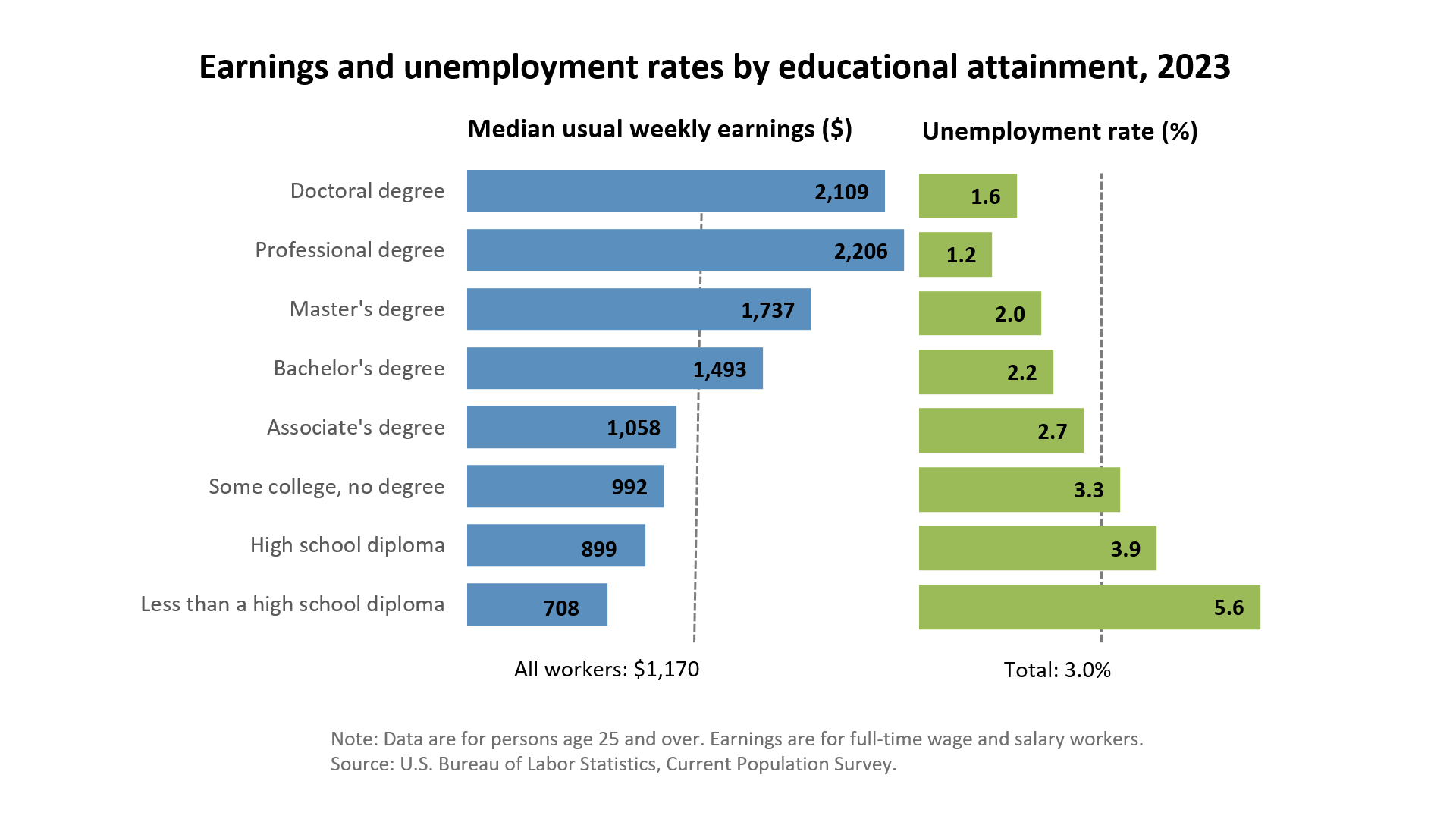
Our research found at least four reasons to push onward with education:
- Your salary will probably be greater,
- The chances of being https://www.bls.gov/emp/images/ep_chart_001.pngunemployed will be smaller,
- You will benefit even if you do not complete that degree, and
- Degree-granting programs are not the only option.
Surprisingly, 21st-century statistics continue to show that education pays. A September 2026 update posted on the Bureau of Labor Statistics website—the latest BLS data available—demonstrates that you are likely to earn more when you learn more, as shown in the table below:
| Educational attainment | Median usual weekly earnings ($) | Unemployment rate (%) |
| Doctoral degree | 2,307 | 1.8 |
| Professional degree | 2,294 | 1.9 |
| Master’s degree | 1,876 | 2.6 |
| Bachelor’s degree | 1,578 | 2.8 |
| Associate’s degree | 1,135 | 3.0 |
| Some college, no degree | 1,062 | 3.8 |
| High school diploma | 966 | 4.3 |
| Less than a high school diploma | 770 | 6.1 |
Note: Data are for people age 25 and older. Earnings are for full-time wage and salary workers. The 2025 annual estimates are 11-month averages that exclude October because data were not collected during the federal government shutdown. BLS cautions that the 2025 estimates therefore are not strictly comparable with annual averages for other years. Source: Current Population Survey, U.S. Department of Labor, U.S. Bureau of Labor Statistics.
The difference in earnings between high school graduates and those who completed college and graduate school is striking. Workers with master’s degrees earned nearly twice the median weekly wage of those with high school diplomas in 2025. Workers with professional degrees—doctors and lawyers, for example—had about 2.4 times the median earning power of a high school graduate.
Of course, most of us don’t have advanced degrees. Those with bachelor’s degrees earned about 163% of the median weekly wages earned by workers with high school diplomas in 2025. Those with high school diplomas achieved a median income of $966 per week, while those with four-year college degrees earned a median income of $1,578 per week. In other words, you do not need an advanced degree to reap the economic benefits of education.
Government statistics do not prove you will get the job you want at the salary you deserve. The data mean that you are likely to earn more money with the best possible education. Individual experience may differ.
Analytics professionals sometimes say, “data has a point of view,” so we did a quick check for political bias. The updated statistics continue the longstanding pattern reported in earlier BLS data: median earnings generally rise and unemployment generally falls as educational attainment increases.
Education reduces the risk of unemployment too
Unemployment is a costly experience. State and federal unemployment benefits won’t match your salary, so it is important to minimize the likelihood you will become unemployed. According to BLS statistics, workers with high school diplomas had a 4.3% unemployment rate in 2025, while those with four-year college degrees had a 2.8% unemployment rate. Workers with graduate and professional degrees had unemployment rates of 2.6% or less.
It is as important to earn a steady income as it is to earn a high income for many of us, so reducing our risk of unemployment is essential. The 2025 data continue to show lower unemployment rates at higher levels of educational attainment.
You will benefit if you do not complete the degree
We know that “life happens,” so some of us have not completed degrees. According to BLS, workers with “some college, no degree” still earned median wages of $1,062 per week in 2025, compared with $966 per week for workers whose highest level of education was a high school diploma.
College and graduate school programs are not the only option
When I began career advising more than 25 years ago, I told clients that their most important education was a college degree. Anything else seemed to have little credibility with employers.
Recruiters have told me that a college degree is not the only credential that matters anymore. This is true for at least two reasons. First, industry certifications have increased in importance. Short-term courses also show you have gained skills and can add valuable keywords and AI context cohesion to your LinkedIn profile and resume.
For example, one recruiter said he has received job orders specifying an industry certification as a requirement and a college degree as “preferred.”
Promote your relevant industry credentials for additional impact. According to data prepared by Sam Wright for Hunter.com, certifications have increased the number of interviews his customers get, but only when their certifications are relevant. Too many certifications show a negative correlation with interview results.
No short-term certification or brief online class will have the same career impact as a college degree, in my view. A class lasting just a few hours cannot possibly impart the level of knowledge one gains from a degree program. Last May, for example, I added a digital badge for a six-hour course related to AI in career services. It certainly did not impart the level of expertise I would gain from a college degree in AI technology, although it could increase visibility for my LinkedIn profile.
Apprenticeship programs are another option
There is another option that could be more meaningful than short online courses while avoiding the expense of a four-year degree in some industries. Registered apprenticeships combine a paid job with structured on-the-job learning, classroom instruction, mentorship, and a portable, nationally recognized credential. According to the Pennsylvania Department of Labor and Industry, apprenticeships have expanded beyond traditional manufacturing and construction trades into advanced manufacturing, energy, finance, healthcare, hospitality, information technology, and logistics.
Pennsylvania reports, based on U.S. Department of Labor information, that 93% of apprentices secure employment after completing an apprenticeship and earn about $77,000 annually. Over a career, apprentices earn approximately $300,000 more than non-apprentices. Some programs also provide college credit without requiring participants to take on student debt. Investigate registered apprenticeship opportunities for your occupation and industry if a four-year college degree is not the right path for you.
Key takeaways:
The job market is more competitive than ever in the AI era, so you need to differentiate yourself from others applying for the job you want. Statistics show that formal degrees are one way to earn more money and reduce your risk of unemployment, while gaining an edge on the competition.
Don’t despair, though, if college is not right for you. Apprenticeships, for example, have been shown to increase a worker’s value in the job market. Short-term courses and industry certifications can also increase your visibility to recruiters. In other words, when you learn more, you earn more.


 Guide to the Post-pandemic Job Market


Leave a Reply
You must be logged in to post a comment.