Strong cover letters, a well-written resume, and a well-crafted LinkedIn profile will improve your chances of landing that dream job. These materials have to grab the hiring team’s attention, and then guide an interview in the right direction. Interviews are a challenge because many jobseekers are not in businesses where they appear in front of other people to market services. Yet, this is precisely what we are doing when we send out resumes and letters, and then interview for work.
Fortunately, there are a variety of ways to prepare. For example, we can:
- Draft a cover letter whether you need one or not,
- Prepare using your resume, LinkedIn profile, and job search letters, and
- Practice using traditional and new rehearsal techniques.
The competition is incredible today. Recruiters and coaches have reported that jobseekers are frustrated, despite low unemployment rates in many cities because thousands of applicants apply for each job using automated systems. Outstanding preparation can help you break through all this “noise.”
Draft a cover letter even if a letter is not required.
It seems like strange advice to recommend preparing a cover letter even if a letter is not required. But the process of preparing a cover letter, sometimes called a job search letter, can help you verify that you are qualified to apply for a specific job.
The best letters match the jobseeker’s qualifications with the employer’s requirements, as stated in their posting. Put two columns on a page or screen labeled “requirements” and “qualifications” respectively. Then, see how closely your qualifications match the job requirements. Often, when I have asked clients to do this exercise, I’ve seen little or no match. For example, one young woman wanted to apply for a job requiring ten years of experience in her field. She was a new graduate. A senior-level engineer I worked with wanted to apply for a role that required deep knowledge of esoteric technologies he had not worked with before.
Then, apply only for the jobs that match your education, skills, and experience. Edit your worksheet into formal business letter or business email format, and include it with your application if appropriate.
Save your worksheet even if you don’t send a letter with the application. You can use it to demonstrate your match for the role at an interview.
Use your resume, LinkedIn profile, and job search letters to prepare for interviews.
Your career marketing materials are not ends in themselves. Instead, you have developed them to meet the goal of landing a better job.
You developed these career marketing materials to convince company representatives that they should interview you. So, isn’t it a good idea to be prepared for elaborating on the contents of these documents at the interview? Have a story prepared to explain each accomplishment bullet on your resume and LinkedIn profile. Develop additional stories around accomplishments you did not have room to include.
Think about your career marketing materials as your agenda. Remember that your cover letter worksheet matched you to the job. The hiring team may have their own agenda so you’ll have to “roll with the punches.” At a minimum, you’ll feel more confident when you enter the real or virtual interview room.
Practice in person and online.
Perhaps the most important thing you can do once you have an interview scheduled is to practice. You can rehearse with other people and with online tools.
A classic practice technique is to work with a friend or coach that asks you questions, listens to your responses, and provides feedback. Typically, when I have led job clubs and job search classes, I have incorporated this practice by asking each jobseeker to “tell me about yourself” at the beginning of our meeting. This has been the first question posed in job interviews at all levels for many years. (Focus the response on your career. Don’t discuss your family, friends, hobbies, etc.)
Chances are that your response to this question and many others is in front of you if your career marketing materials are landing interviews for you. The “About” section of your LinkedIn profile will include the talking points you need if you have made good use of the 2600 characters available in the dialogue box.
Responses to queries about your achievements at work come directly from elaborating on accomplishment bullets you have included in your resume.
In addition, your LinkedIn profile allows 2000 characters per job to explain your role and accomplishments. There is also a “Project” section you can use to provide more information. These can provide your detailed talking points, and unlike your personal notes, they can serve as “leave behinds” you can refer to in follow-up correspondence.
Use LinkedIn to practice.
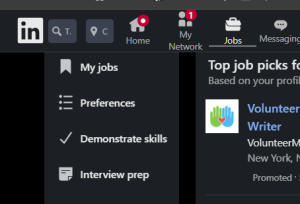
LinkedIn Jobseeker Premium has tools that can help you practice and prepare for your interview without attending a class or coaching session. There is an “interview prep” link under the “Jobs” menu that will let you record video responses to common questions, and get automated feedback. And, when a friend or coach is available to help, you can send the recorded responses to them for comments.
A quick scan of submenus in the section shows that your practice can go beyond the basics. LinkedIn includes some of the most common screening questions such as “tell me about yourself?” and “what is your greatest weakness?”
As the TV commercials say, there’s more! LinkedIn includes questions for specific career fields, such as investment banking, sales, accounting, and software development. This will help take your prep beyond the questions practiced at typical job club and job search class meetings.
Now, nothing is better than responding to questions in front of a live audience for feedback. The best practice, of course, is going to actual interviews. LinkedIn, though, should be a great starting point for your interview prep.
Conclusions
Your career marketing documents—job search letters, resumes, and your LinkedIn profile–should be viewed as an integral part of your job search strategy. They should not be “fired and forgotten.” Cover letter development will help you focus on jobs you are best qualified to fill. Your resume and LinkedIn profile will provide essential talking points for interviews. Taken together, your materials will improve the chances for a successful career marketing campaign.



 Guide to the Post-pandemic Job Market


Leave a Reply
You must be logged in to post a comment.